Posts

Life in the Mini panels of Halebeedu

Image
The Hoysasleshwara Temple of Dwarasamudra built  in 1121 CE by Ketamalla, General of Vishnuvardhana,  is rightly famed for  its profuse ornamentation , the dynamic ,large figures on the outer walls and the incredibly detailed ceiling slabs. It also has tiers and tiers of smaller friezes , crammed with innumerable figures of people and beasts, both real and mythological , all around the outer walls, the accordian like folds of which give a large surface area to work upon. Life  lies in these smaller details . The apprentices of the sculptors' guild that worked here must have had a free hand in choosing their motifs. And like modern day Art Students going  all out  with their ideas and techniques on public walls, those acolytes seem to have  given free rein to their imaginative best. Rows of elephants, each one doing its own thing, the more orderly Vyalas and horses , warriors, citizens enjoying music and dance , along with characters from the Epic...
Same...yet different.

Image
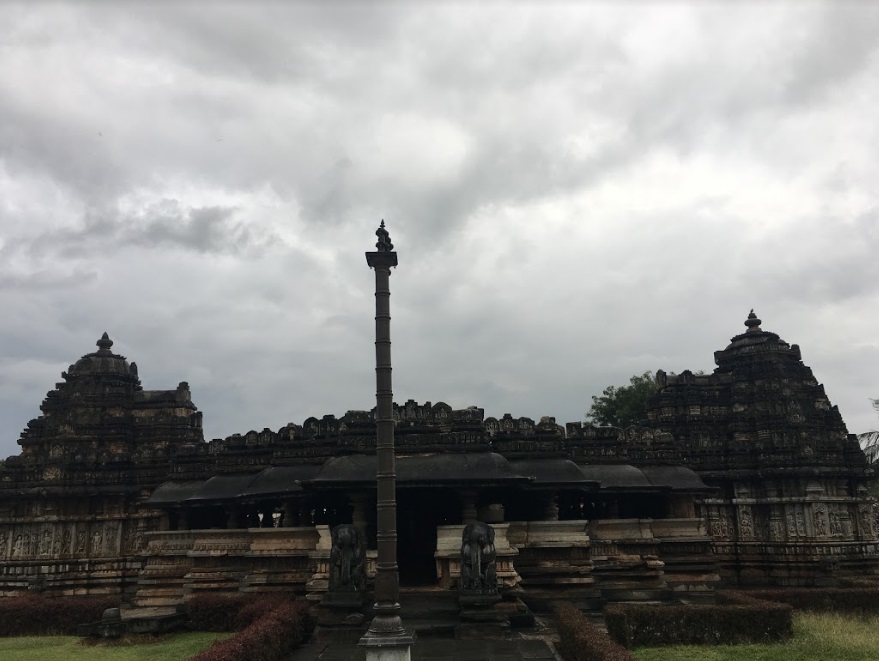
BELAVADI VEERANARAYANA TEMPLE According to one estimate , the Hoysalas  (Kings, Queens, Commanders and Ministers) built close to 1500 temples, big and small, between 1026 CE when they came to power to 1343 CE when they were finished off by Muslim forces from Madurai. Among those, about 550 temples have survived  ruin and remain standing to this day, in various states of preservation. Hoysala architecture, though much influenced by Chalukyan idiom, took on a very unique character when soapstone quarries were discovered and worked by them. Soapstone being a better material to work with than granite, which was being used till then, the architects and sculptors went all out to explore all possibilities with the material and came up with stunning results. Building on a raised jagati ( platform), incorporating multiple shrines within a single temple, creating remarkable 'lathe turned' pillars and giving importance to profuse ornamentation became their hallmark. Many celebrate...

In The Shadow of A More Famous Name

Image
What is  it like to be put in the shadow of a twin   who, by whatever means or for whatever reason, has become a giant, a superstar much in demand by adoring crowds , when both have same stories of origin and the same claim to special status ? In human terms, that would be a sad state of affairs, of course, causing emotional instabilities and much angst.  But Divinities care a fig !  Nevertheless,  it is   an interesting study in contrast for a visitor . Mamleshwar ( /Amleshwar/Amreshwar) and Omkareshwar lie opposite each other on either side of the River Narmada and both are considered the Jyothirlingam. Not in plural.   They are considered The Same   Jyothirlingam ! And therein lies the rub,  of why one twin gets the limelight and the other a mere nod ! There are three theories about this. Theory 1 : Mamleshwar is the original and only Jyotirlingam of the holy site , Omkar was built later on a tribal shrine, appro...

BLING-ed out in St.Petersburg

Image
Having done just some rudimentary homework before embarking on the trip to St.Petersburg , i  was only prepared for the grandeur of The Hermitage Museum and the riches of Faberge Museum . But it turned out that St.Petersburg is just awash with BLING. A pointer was the enormous  2storey high video installation  in the Pulkova Airport ,St. Petersburg , showcasing the Art and History of the place (below) that greeted one on arrival . Now to the sights . The First visit in the city had to be .... The Faberge Museum ! And it had not just the Eggs ! There were colour coded rooms , exhibiting all sorts of treasures the Tsars cluttered their homes with . The Museum is a private exposition run by a Foundation that first purchased from Forbes, a load of masterpieces created by  Faberge , the acclaimed jeweler to the Tsars. More acquisitions followed and now there are more than 4000 articles on show in the neoclassical  Shuvalov Palace ( dated to 1780s) by the...

A treasure-house to knock you out

Image
As descriptive words go, where does "Opulence " end and "Flashy" begin ? Understandably, a pretty wide margin needs to be given when possessions  of Royalty are involved. Still, there are some palace museums that can overwhelm and suffocate a viewer with rich clutter. Even eyes that appreciate  fine things  need to blink and shakeout excess in places like ...... ROSENBORG SLOT ( or Rosenborg Castle) ! Situated within  the well laid , 12 hectare Kongenshave ( King's Garden) in central Copenhagen , is a this beautiful building in Dutch Renaissance Style . It was reportedly under construction for 28 years and finished in 1633 to be the Royal Residence of King Christian IV. It is now a museum exhibiting the collections , mostly of that monarch , with subsequent additions by his successors. It was opened for the public in 1838. Visitors can tour all the floors with an audioguide that gives very detailed commentary about the objects and the period . Kongern...

A 'Fort'uitous detour.

Image
It was not the intended destination . But we were destined to land there   !  On a journey to Seebi , a minor error in map-reading put us on the two lane highway , where we were stuck   with a never ending median , making it tough to reverse the direction. A signboard for Sira showed up before the   median relented with any   gap for U Turn. But the name Sira rang a bell , a big clanging bell .  Sira ! We were in the vicinity of a historical place that gave the prototypes for all the grand edifices we Bengalureans take pride in : The Bangalore Fort , Lalbagh and Tipu's Palace ! The prototypes are all gone with history. Sira is a small town now, with just the ghost of a Fort  left . But the  name beckoned as with a Siren Song ! Seebi   was unceremoniously put on the backburner and the destination reassigned . Onward to   Sira Fort then ! SIRA ( originally called Siria ) has a long and checkered history of bei...